
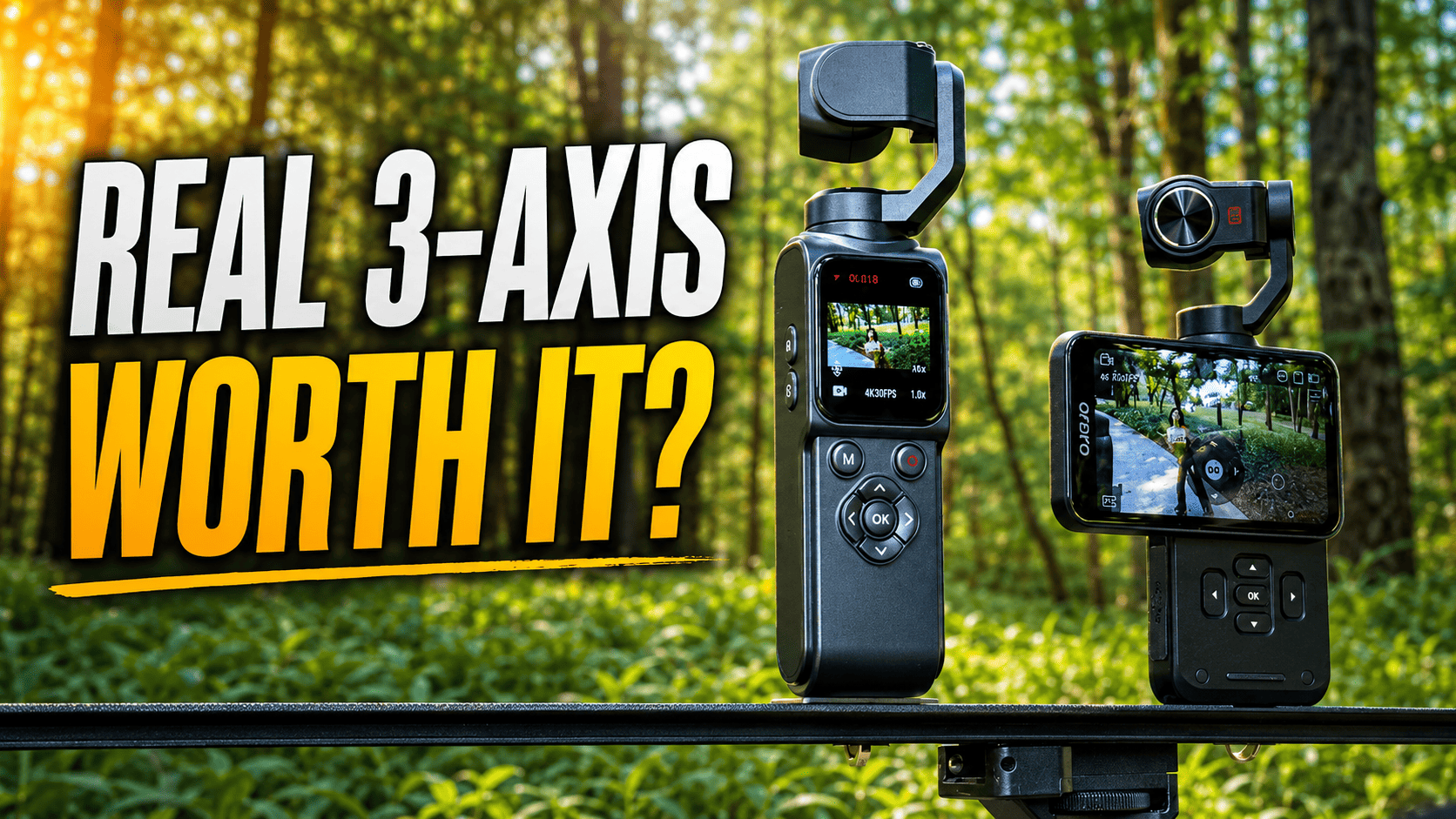
3-Axis Gimbal vs Budget Pocket Camera: What’s the Real Difference?
At first glance, many pocket cameras look surprisingly similar.
They're small, lightweight, easy to carry, and often advertise features such as high-resolution video and stabilization.
So why can one pocket camera cost around $100 while another uses a true mechanical 3-axis gimbal?
The difference becomes much easier to understand once you start moving.
We recently recorded a side-by-side stabilization comparison using the ORDRO M5 and a lower-cost pocket camera. Instead of comparing specifications on paper, we wanted to show what travelers and beginner vloggers actually care about:
What happens to the footage when you're holding the camera and moving?
▶️ Watch our real 3-axis gimbal vs budget pocket camera comparison below.
If you're deciding whether a true 3-axis gimbal is worth it for travel, family videos or everyday vlogging, here's what you should know.
Quick Answer: Is a 3-Axis Gimbal Really Better?
Yes—if you regularly film while moving.
That physical stabilization is particularly noticeable when you're walking, changing direction, following another person or filming handheld travel footage.
For stationary recording, that difference may not matter very much.
Once you begin walking, however, stabilization becomes much more important.
ORDRO M5 vs Budget Pocket Camera: Quick Comparison
| Feature | ORDRO M5 | Typical Budget Pocket Camera |
|---|---|---|
| Stabilization | True 3-axis mechanical gimbal | Often electronic or limited stabilization |
| Best Use | Walking, travel, vlogging | Casual and mostly stationary recording |
| Moving Footage | Designed to remain smoother | More movement may remain visible |
| Camera Movement | Mechanical compensation | Often software-based |
| Large Display | 3.5-inch screen | Usually smaller |
| External Microphone | Supported | Varies |
| Face Tracking | Supported | Varies |
| IR Night Vision | Built in | Rare |
| Best For | Travel, family video, beginner creators | Occasional casual recording |
The most important difference isn't the number printed on the box.
It's what happens to your footage after you start moving.
What Does a True 3-Axis Gimbal Actually Do?
A traditional camera moves whenever your hand moves.
When you walk, your body naturally creates small vertical, horizontal and rotational movements. Those movements are transferred into the footage.
Pan stabilization
Pan controls horizontal rotation.
Imagine walking through a city and turning the camera toward a family member beside you. A gimbal can help make that change of direction feel smoother rather than abrupt.
Tilt stabilization
Tilt handles up-and-down movement.
This is particularly relevant when walking because each step naturally causes the camera to rise and fall.
Roll stabilization
Roll compensates for the camera leaning from side to side.
This helps keep horizons and vertical objects from constantly tilting as your wrist moves.
When all three axes work together, the result is footage that generally feels calmer and easier to watch.
This is why 3 -axis gimbals are commonly useful for:
- Walking videos
- Travel vlogging
- Following another person
- Family vacations
- City exploration
- Handheld creator footage
Shaky footage while moving is the problem you're trying to solve, the stabilization system deserves more attention than simply comparing 4K versus 5K labels.

What Should You Look for in a Real Stabilization Test?
When watching our side-by-side comparison, don't focus only on sharpness.
Look at four things.
1. Vertical bounce
Watch what happens every time the camera operator takes a step.
Does the image noticeably jump up and down?
2. Horizon movement
Look at buildings, doors, walls or the horizon.
Do they remain relatively level, or does the scene tilt as the camera moves?
3. Overall viewing comfort
This is the most important test.
Specifications tell you how a stabilization system works.
But viewers don't watch specifications.
They watch the finished footage.
When Is a 3-Axis Gimbal Actually Worth It?
Not everyone needs one.
But there are four situations where the difference becomes particularly useful.
Travel
Travel recording rarely happens while standing still.
You might be walking through an old town, exploring a market, visiting an attraction, following family members or recording while sightseeing.
A stabilized pocket camera lets you keep moving instead of stopping every time you want a usable clip.
Beginner Vlogging
Walking introductions and talking-to-camera shots immediately expose excessive camera shake.
For new creators, better stabilization can improve footage before they learn more advanced filming techniques.
Family Videos
Children, pets and family members rarely stay still for the camera.
If you frequently follow people while recording, mechanical stabilization becomes more useful.
Everyday Creator Content
YouTube videos, Reels, Shorts and travel clips often combine stationary and moving shots.
A gimbal gives beginner creators more flexibility without carrying a separate camera and handheld stabilizer.

When Is a Budget Pocket Camera Enough?
A cheaper pocket camera still makes sense for many people.
You may not need a mechanical gimbal if:
- Most of your videos are stationary
- You mainly record birthdays or short family clips
- You use the camera only occasionally
- You normally film from a tripod
- Your budget is the highest priority
- You don't mind some movement in handheld footage
For example, if you're recording a birthday cake from across the table, a basic pocket camera may be completely sufficient.
The value of a gimbal becomes much clearer when your normal filming style is:
walk + record + follow.
Why the ORDRO M5 Takes a Different Approach
Its core difference is the combination of a true 3-axis gimbal and everyday usability.
That gives users more flexibility depending on whether they're walking, following another person or trying to maintain a fixed direction.
Large 3.5-Inch Screen
Ultra-small cameras often come with very small displays.
Compact size is useful—but a tiny screen can make framing, reviewing footage and changing settings frustrating.
The M5 uses a 3.5-inch screen, giving more viewing space for:
- Framing shots
- Reviewing recordings
- Navigating settings
- Checking whether faces are in frame
That can be particularly helpful for users with larger hands, older travelers or anyone who simply prefers a more comfortable interface.
 External Microphone Support
The M5 includes a built-in microphone and a 3.5mm microphone input.
Beginners can start with the camera alone, then add an external or wireless microphone later if talking-to-camera audio becomes more important.
Face Tracking
Face tracking can help when filming yourself or another person, especially for casual vlogging and family recording.
IR Night Vision
The M5 also includes three built-in infrared LEDs.
IR night vision is a specialized feature that produces monochrome footage in very dark environments and can be useful for camping, nighttime observation and creative low-light recording.
It's an unusual feature to find alongside a mechanical gimbal in a compact camera.

Which One Should You Buy?
| How You Shoot | Better Choice |
| Mostly stationary family clips | Budget pocket camera may be enough |
| Walking travel videos | 3-axis gimbal camera |
| Beginner travel vlogging | 3-axis gimbal camera |
| Occasional short videos | Budget pocket camera |
| Following children or family members | 3-axis gimbal camera |
| Lowest possible budget | Budget pocket camera |
| Smooth handheld footage is a priority | 3-axis gimbal camera |
| Travel + vlog + external microphone | ORDRO M5 |
The goal isn't to pay more simply because one camera has more features.
The goal is to spend money on the features that solve the problems you actually experience.
Final Verdict: Is a 3-Axis Gimbal Worth It?
A 3-axis gimbal isn't necessary for everyone.
If you mainly record stationary scenes, short family clips or occasional videos, a lower-cost pocket camera may already do everything you need.
But if you regularly film while walking, traveling, following family members or creating vlogs, the difference becomes much easier to appreciate.
A true mechanical 3-axis gimbal doesn't simply add another specification to the product page.
It changes how the camera behaves when you move.
That's where the ORDRO M5 makes the most sense.
It combines mechanical 3-axis stabilization with a large 3.5-inch display, external microphone support, face tracking and infrared night vision in a compact camera designed for travelers, families and beginner creators.
Our Takeaway
Don't choose a pocket camera based on resolution alone.
If smoother moving footage is one of your priorities, stabilization deserves just as much attention as 4K or 5K.
Frequently Asked Questions
What is the difference between a 3-axis gimbal and electronic stabilization?
A 3-axis gimbal physically moves the camera assembly to compensate for movement across pan, tilt and roll. Electronic stabilization relies primarily on software processing to reduce visible movement in the recorded image.
Is a 3-axis gimbal worth it for a pocket camera?
It can be particularly worthwhile if you regularly record while walking, traveling or following moving subjects. For mostly stationary recording, the benefit may be less important.
Is a gimbal better than EIS for walking videos?
A mechanical gimbal physically compensates for larger camera movements, while EIS relies on electronic correction. The practical difference is often easier to notice during walking and direction changes.
Does a 3-axis gimbal improve video resolution?
No. Stabilization does not increase resolution. Its purpose is to reduce unwanted camera movement so the footage is easier to watch.
Is the ORDRO M5 a real 3-axis gimbal camera?
Yes. The M5 uses a mechanical 3-axis gimbal and provides multiple gimbal-following modes for different shooting situations.
Is the ORDRO M5 good for travel vlogging?
The combination of 3-axis stabilization, compact design, a 3.5-inch screen, face tracking and external microphone support makes the M5 particularly suitable for beginner and everyday travel vlogging.
Should I buy a cheap pocket camera or a gimbal camera?
Choose a budget pocket camera if price and occasional stationary recording are your main priorities. Choose a gimbal camera if you expect to walk, travel, vlog or follow moving subjects regularly.
See the Difference for Yourself
The easiest way to understand stabilization isn't to read another specification sheet.
Watch our real 3-Axis Gimbal vs Budget Pocket Camera comparison above and pay attention to what happens when both cameras start moving.
If smoother walking footage is what you're looking for, explore the ORDRO M5 and decide whether a true 3-axis gimbal better matches the way you shoot.
Related Guides
Best Pocket Camera for Travel 2026
Learn how stabilization, portability, screen size and ease of use affect a compact travel camera.
How Content Creators Should Choose an M5 Kit
Discover which M5 camera combination best suits your needs and which accessories are essential.
Written by: ORDRO Camera Team
Last Updated: August 14, 2026
About ORDRO
ORDRO develops accessible cameras and camcorders for travelers, families, creators and imaging enthusiasts. This article is based on ORDRO's own side-by-side stabilization comparison between the M5 and a budget pocket camera.
© 2026 ORDRO. All rights reserved.
Share:
ORDRO EP8 Setup: Power, Wi-Fi, and SD Card Guide
World Photography Day: Affordable Cameras for Everyday Moments